
When the Boy Scouts of America, recently rebranded as Scouting America, gathers in Dallas May 11-15 for its National Annual Meeting, its leaders will confront a crisis that messaging cannot solve. At the end of 2025, the organization’s market share sank to about 1.25 percent of American youth, the lowest since about 1923. The organization has not strung together a multi-year recovery in 25 years.
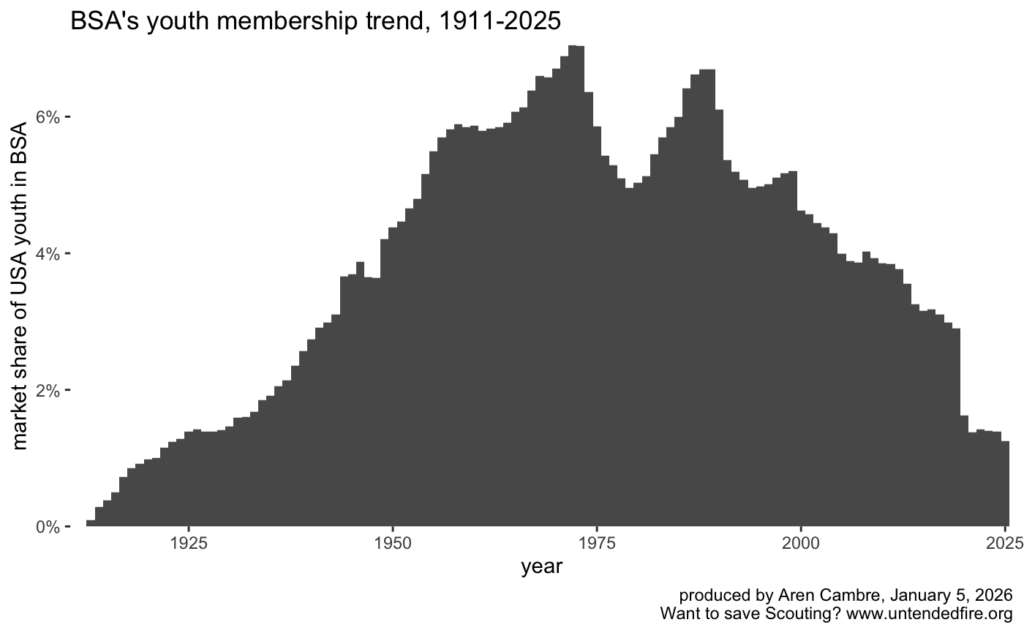
BSA’s decline is not the generic story of a youth organization losing ground to phones, sports, or overscheduling. Those affect everyone. BSA’s problem is more specific. Its historic advantages—brand recognition, inexpensive outdoor access, and the prestige of Eagle Scout—once masked program defects. As those advantages diminish, families see the defects more clearly.
The obstacle is BSA’s national culture. Inside BSA, career advancement and volunteer appointments are too often detached from producing better youth programs. Instead, they are commonly prestige markers awarded to those who avoid candor. Accountability is optional; institutional deference is not. The result is a class of insiders who deny decline with cheerful press releases while treating internal critics as disloyal.
This culture validates bad ideas. The clearest example is the program Americans still picture when they hear “Boy Scouts”: Scouts BSA, the tan-uniform program that runs from 10-year-old fifth-graders to high-school seniors. No school, sports league, or serious youth-development program would treat children leaving elementary school and young adults preparing to graduate as one developmental audience. BSA does.
This pattern extends to BSA’s other programs. Cub Scouts makes fifth graders share a program that also accommodates kindergartners. Venturing and Sea Scouts run from eighth graders to 20-year-old adults. The pattern is not developmental clarity. It is administrative convenience.
BSA is an outlier in world Scouting. International peer organizations typically use age spans of three to five years, and none merge middle schoolers and high schoolers into one program. Those age bands are where development moves fastest, and BSA chose to blur it.
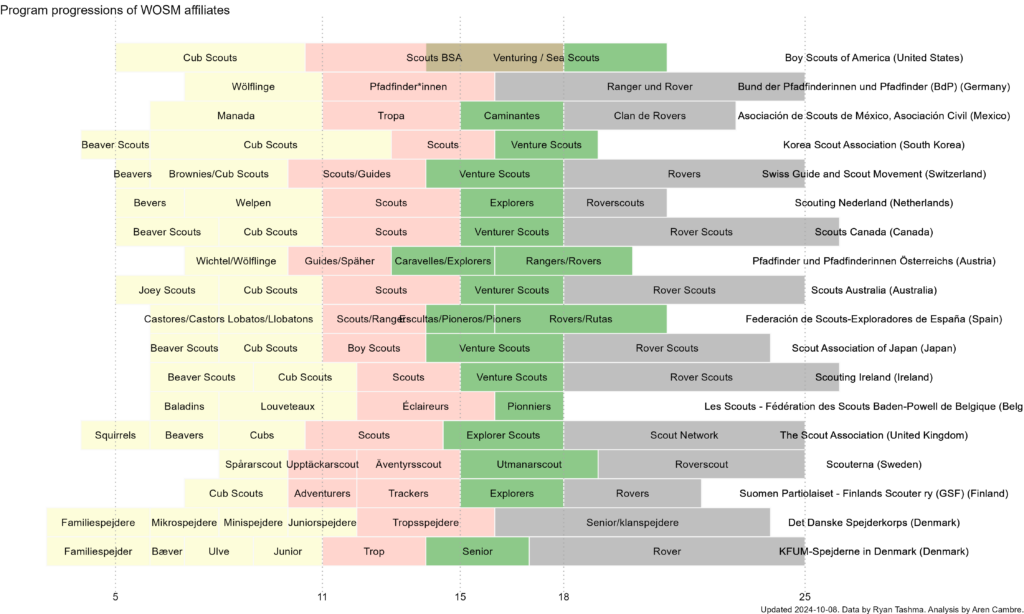
The cost falls on both ends of Scouts BSA. That program is optimal for middle schoolers, but middle schoolers are not trusted to own it. They are managed by older youth instead. High schoolers fare no better. Instead of receiving programming built around autonomy, peer challenge, advanced outdoor adventure, and responsibility suited to their age, the vast majority are trapped in a middle-school program where their main role is supervising the younger Scouts. BSA romanticizes this as mentoring. Teenagers see it as babysitting. They know the difference, and they leave.
That culture’s deepest failure is conceptual. Leadership is a key Scouting promise, the only item common to its methods and aims, and the promise BSA often invokes to justify Eagle Scout1, youth offices2, patrols3, and adult training4. But leadership is not a patch. It is not a title, office, authority, or chain of command. Leadership is influence: persuading voluntary followers to move toward a shared vision for change.
BSA has spent decades replacing leadership with administration. This substitution is evident in how BSA replaced the patrol method with a corporate-bureaucracy simulation. Widely used internationally, the patrol method is small, independent, self-governing teams of youth making real decisions, solving real problems, and learning through consequences. It centers on the patrol and Patrol Leader. Decades ago, BSA evicted the patrol method in favor of emerging corporate-management theories5. Patrols became roster slots inside a bureaucracy of titled youth roles, layered reporting6, meeting scripts7, and committee procedure8. BSA never stopped saying “patrol method.” It preserved the vocabulary while replacing the operating system.
Wood Badge, the organization’s premier adult-training program, reinforces the substitution. Marketed as leadership training, it functions mainly as a bureaucrat-polishing school. Adults rehearse the corporate-bureaucracy simulation and return home to faithfully implement what undermines leadership development.
The Eagle Scout rank illustrates the same drift. American society gives BSA an extraordinary gift: it treats Eagle as a distinction among high schoolers, a signal of maturity and leadership. BSA undercuts that gift. Eagle is just part of a middle-school advancement ladder, and 11-year-olds can earn it.9 Instead of certifying tested leadership, it often rewards advancement velocity, compliance, and tenure in bureaucratic titled offices. Its famous service project is mostly a worksheet exercise10, accompanied, tellingly, by no project-management training.
The culture’s aversion to candor extends to public missteps. After emerging from a sexual-abuse bankruptcy, BSA rebranded itself “Scouting America.” The new name initializes to “SA,” common shorthand for sexual assault. National leadership appears to know: BSA forbids use of the SA acronym, and on its official volunteer forum, national bureaucrats censor SA. When an initialism-rich organization chooses an initialism-prone brand yet forbids the initialism, it admits competence and candor problems.
The institutional priorities are visible elsewhere. BSA’s 2024 audited statements list about $329 million in debt, including roughly $186 million in bonds for a West Virginia facility that in 2023 was utilized 97 percent below expectations. And when Secretary of War Pete Hegseth threatened military support, BSA quickly abandoned DEI initiatives, discontinued the Citizenship in Society merit badge, and undid inclusive policies. While readers may disagree about those policies, the institutional lesson is clear: BSA can act fast when outside pressure threatens the convenience or prestige of its national bureaucrats. It does not act at all when youth flee its programs.
Dallas is the moment for truth. A serious agenda would begin with admissions: middle-schoolers deserve ownership of their own program; high-schoolers deserve a program built for their life stage; the corporate-bureaucracy simulation must be evicted and the patrol method restored; adult training must focus on genuine leadership; Eagle’s public meaning is being squandered; and the new corporate brand is an unforced error. These are starting points, not the full agenda. None of this requires another pilot program. It requires leaders willing to name the problems in public.
This hard work is unlikely. Reform at BSA follows a familiar arc: stalled for decades, then bungled when finally implemented. The admission of gay members and girls took this course. National leadership has convinced itself that doing little, offending no one, and appeasing every constituency will produce the turnaround it needs. It will not.
The membership trendline does not care about institutional feelings. If national leadership will not eat a few sacred cows in Dallas, the organization will be eaten by its own irrelevance. Anything less than candor is cheerful packaging around continued neglect. And if inaction means high-schoolers will remain in a middle-school program to supervise younger youth, BSA should at least have the honesty to pay the babysitters.
Continue the conversation
Keep the discussion going by leaving a comment below or joining social-media groups friendly to discussing Scouting’s hard topics:
- Scouters: Not Afraid of Controversy on Facebook
- r/BSAOpen on Reddit
- Untended Fire on Discord
- This justification is typically in loose language, but a specific example is in BSA’s 2024 Report to the Nation, where Eagle Scouts are introduced as exemplifying character, leadership, and service. ↩︎
- In the Troop Positions page of the Troop Leader Resources website, BSA lists the 16 different titled roles for Scouts BSA. These are titled roles in a child-sized corporate-bureaucracy simulation. ↩︎
- In the Patrols page of the Troop Leader Resources website, BSA references the Brownsea Island experiment. There, BSA praises the patrol method as the “one essential feature” of Scouting. In the patrol method, patrols are largely independent, and Patrol Leaders are elevated, being mentored directly by the Scoutmaster. Ironically, BSA undermines this “one essential feature” with its corporate-bureaucracy simulation, which changes Scouts BSA from where “[t]he patrol is the unit of Scouting always” to the troop itself being the essential unit, with patrols buried under the bureaucracy. ↩︎
- For most, Wood Badge is seen as the ultimate adult-training goal. Regrettably, Wood Badge has been undermined, reduced to mainly training on how to act as a corporate middle-manager and an extensive dress rehearsal of the Scouts BSA corporate-bureaucracy simulation. ↩︎
- The White Stag initiative seems to have been especially influential on the Scouts BSA design. While its focus on the ways of corporate middle management has value, that is different than leadership. By confusing management with leadership, BSA has undermined its leadership training for youth and has misinformed generations of adult leaders. ↩︎
- The Troop Structure page of BSA’s Troop Leader Resources website reveals that troops are a complex, youth-run bureaucracy. This contrasts starkly to the patrol method, still practiced nearly universally in the rest of the world, which generally only has patrols and Patrol Leaders and no child-sized bureaucracy. ↩︎
- BSA’s model treats the troop meeting as a scripted, centrally coordinated procedure rather than as the natural expression of independent patrol life. Its Troop Meeting Agenda page of the Troop Leader Resources site illustrates this, describing the weekly troop meeting as something to be managed through “planning and preparation”, directs the Patrol Leaders’ Council to use a “Troop Meeting Planning Form” to keep the meeting “organized and productive”, and divides a standard meeting into prescribed components. The form further structures the meeting by activity, description, who will run each part, and time allocation. This is not objectionable merely because it is an agenda; the point is that the script is the central part of a bureaucracy-run agenda, subsuming independent patrols into a corporate simulation. ↩︎
- In the Patrol Leader’s Council Monthly Planning page of Troop Leader Resources, BSA shows the committee layer that squashed patrol life. The page defines the Patrol Leaders’ Council as a monthly body that “fine-tune[s]” the troop program, composed of titled officeholders and attended by a scribe who takes notes and keeps minutes. It calls the PLC the troop’s “elected and duly appointed governing body” and assigns it responsibility for the “planning, preparation, and presentation” of the troop program, with a meeting agenda and planning worksheets linked below. This is youth administration, not leadership. Under this corporate-bureaucracy simulation, Patrol Leaders are pulled into a troop-wide committee procedure, and patrols are diminished as components of a managed troop program. ↩︎
- The shortest path to Eagle is 19 months. A Cub Scout can switch to Scouts BSA upon earning the Arrow of Light badge. As long as the Arrow of Light is earned within 5 months of turning 10, then that Scout can earn Eagle as an 11-year-old. ↩︎
- The Eagle Scout Service Project Workbook is a 32-page PDF that is often accompanied by additional materials. The Eagle candidate can easily spent many more hours on paperwork exercises than in the project itself. ↩︎


Leave a Reply